
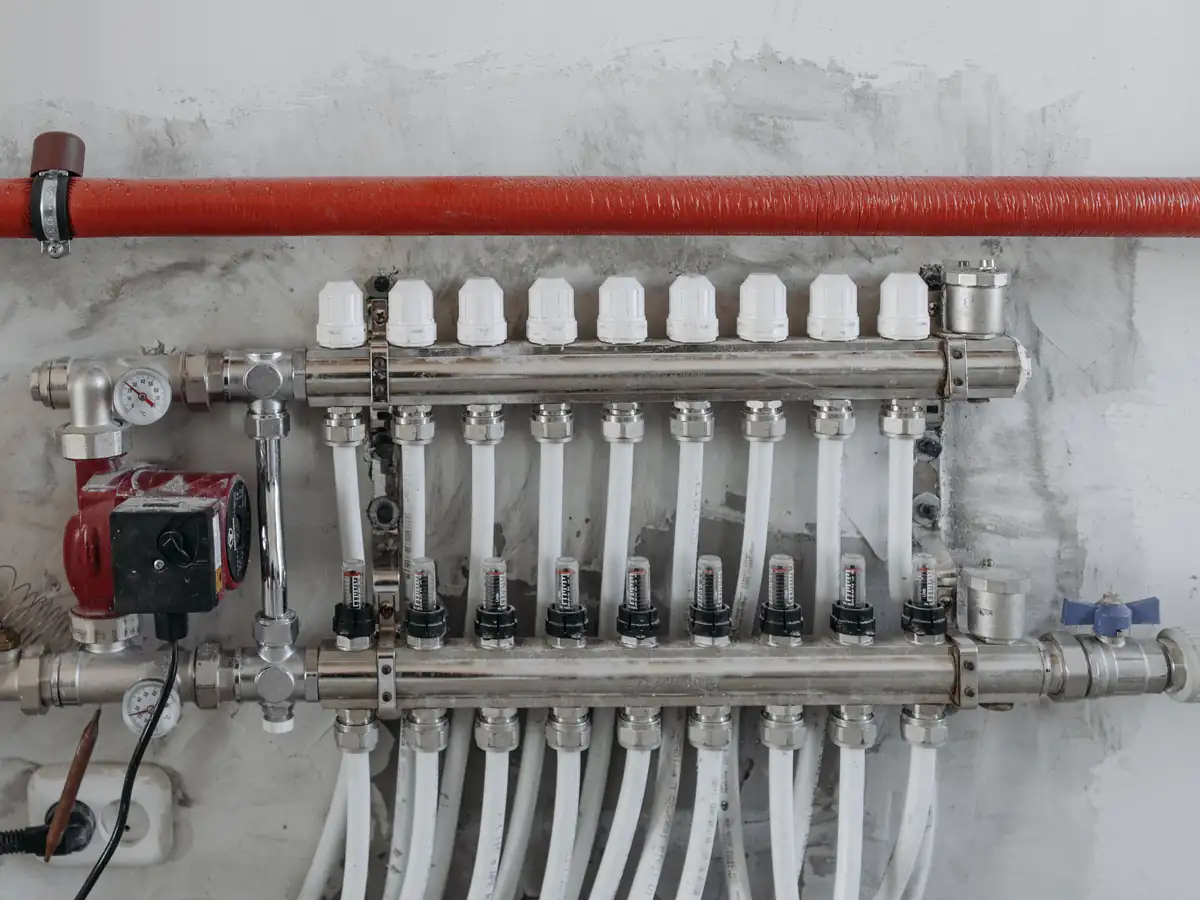
Gas fitting for homes and commercial kitchens
Gas lines and appliance connections across Oceanside and the Alberni Valley, from a range at home to a full commercial cooking line.
What a gas fitter is actually doing
The pipe and the connection, from the meter to whatever burns the fuel.
Gas fitting is the line, the shut-off at the end of it, the test that proves the line holds, and the vent where a vent is required. The appliance is the other half of the job, and the two usually arrive on the same visit.
Two calls make up most of the work. Someone has bought something that burns gas and needs a line run to it or a connection made at it. Or a line that already exists is being moved, capped or replaced because a room is changing shape.
We do gas fitting alongside the heating and refrigeration work, which is why it often turns up inside a job you called about for a different reason. A furnace change, a rooftop unit, a kitchen fit-out: the gas side belongs to the same crew and the same visit.
In British Columbia this is regulated work. Contractors and companies working with regulated systems and equipment must be licensed by Technical Safety BC, and regulated gas work carries a permit. Ask any contractor for the permit before the work starts, including us.
Two very different gas jobs
A commercial kitchen and a family house need the same trade, and they have almost nothing else in common.
In a commercial kitchen
- The cooking line Ranges, fryers, griddles and broilers, the manifold that feeds them and the isolation valve at each one.
- Rooftop units The gas run to a packaged unit on the roof, which is usually the same visit as the unit itself.
- Make-up air heaters The gas side of the heater that tempers the air a kitchen exhaust hood pulls out of the room.
- Moves and capping A line capped properly when a piece of equipment leaves, instead of a valve nobody wants to touch.
- Testing A pressure test on the line before anything is fired, and the paperwork that follows it.
The hood itself, its fan and the make-up air behind it are their own piece of work. That is on commercial kitchen hoods.
At home
- Ranges and cooktops The line behind the appliance and the connection at it, including the case where the store has delivered a gas range and left it standing in the middle of the floor.
- Dryers A gas dryer wants its own line and its own shut-off, which is the part people find out about after the dryer arrives.
- Fireplaces and inserts The supply line to the appliance and the venting that has to go with it.
- Barbecues and patio heaters A fixed line out to a deck or a patio, so nothing has to be carried back from a filling station in February.
- Furnaces and heaters The gas side of a heating appliance when it is being changed, moved or taken out.
If the appliance is a furnace that has stopped working, start on furnace repair instead. That is a diagnosis before it is a gas job.
If you smell gas
This is the one call that does not come to us first.
Those three steps are FortisBC's own, on its gas leaks and odour page. Once the utility has been out and the line is safe, the appliance or the pipe still has to be put right, and that part is an ordinary service call.
How a permit job runs
Four steps, and Technical Safety BC sets all four of them.
- 01 The permit Regulated gas work carries a permit. Technical Safety BC issues it everywhere we work, and its own homeowner guidance is that a licensed contractor applies for it on your behalf.
- 02 The work The line goes in or gets altered, the appliance is connected, and the line is pressure tested before gas is put on it.
- 03 The filing A gas notification of completion, installation or alteration goes to Technical Safety BC after each phase, and at least once inside 180 days of the permit being issued.
- 04 The assessment Technical Safety BC processes that filing and decides whether the job needs a physical assessment. On a homeowner permit you request an inspection yourself, at least one inside the same 180 days.
Gas installation permits and homeowner gas permits, Technical Safety BC. It issues the permit itself everywhere we work: the six places where the municipality issues it instead are Burnaby, Maple Ridge, North Vancouver, Kelowna, Richmond and Vancouver.
Where we take gas work
Oceanside first, then along the Island Highway and up Highway 4 into the Alberni Valley.
Parksville
Ranges, dryers, fireplaces and deck lines at home, and the cooking line behind the counter in a commercial kitchen.
Qualicum Beach
The shop is in town. When the appliance arrives a week after the line went in, coming back for it is a short trip.
Nanaimo
Down Highway 19 from the shop. Ranges, dryers and fireplace lines at home, and the gas side of a commercial kitchen.
Port Alberni
The Valley is where the gas is. FortisBC counted 4,055 residential and 404 commercial connections here in 2022, and every FortisBC gas connection in the Alberni-Clayoquot Regional District is in this town.
Also covered Nanoose Bay French Creek Coombs Errington Bowser Qualicum Bay Deep Bay Lantzville Ladysmith Chemainus Duncan Courtenay Comox Cumberland Campbell River and across Central Vancouver Island, from Campbell River to Duncan
Tofino and Ucluelet are missing from this list on purpose. Neither town has a FortisBC natural gas connection, so gas out on the coast means propane from a bottle or a tank, which is a separate question and one to put to us directly. Both towns stay on the list for refrigeration and heat pumps: Tofino and Ucluelet.
Gas questions we get asked
Do I need a permit to have a gas appliance connected?
The store delivered our gas range and left it. Can you connect it?
Can you run a gas line out to a barbecue or a patio heater?
Our furnace is gas. Is that the same call?
What do we do if we smell gas?
Tell us what needs connecting
What the appliance is, where it is going, and where the nearest gas line runs. That is usually enough to size the job.